Free HarvardX Course: Unlocking the Immunity to Change: A New Approach to Personal Improvement

Hello 2015!  Time does fly too fast!  Every year, many of us make New Year’s resolutions on self improvement, yet how many of these do we actually realize? If we pause to reflect and honestly admit to ourselves that we often fall short rather than succeed, then learning about and applying the Immunity to Change process to yourself can make a huge difference to help you be more successful with your goals.

I’ve finally had the opportunity to read the book Immunity to Change: How to Overcome It and Unlock the Potential in Yourself and Your Organization by Robert Kegan and Lisa Laskow Lahey.  I decided to check the authors’ website http://mindsatwork.com/ at that time and discovered that they were just about to conduct an experimental research based online class on the Immunity to Change (ITC) process and how effective it might be if taught in an online course. It was a free course by HarvardX on https://www.edx.org/. What a great experiential way to learn about the Immunity to Change approach and process, in addition to reading about it!

I signed up to the course HarvardX: GSE1.1x Unlocking the Immunity to Change: A New Approach to Personal Improvement and completed the 13 weeks, starting September 16 and ending December 15, 2014. I enjoyed the learning experience with Kegan and Lahey giving many short video lectures throughout the course to explain the key concepts,  and with volunteer students who are sharing their Immunity to Change X-rays as they create them one step, one column, one week, at a time…in class.  The discussion forum was a great way to learn from and with other course participants. The online Change Diary was a truly a useful tool in helping us learn and apply the ITC process to ourselves.EdX_Login_Immunity.to.Change

I learned a lot from the course.  These include, but are not limited to the following:

  • How to create your own Immunity to Change Map or “X-ray” and how to apply the ITC process to yourself.
  • One reason we fail at our self improvement goals is that we often apply a “technical approach” to change when what is needed is an “adaptive approach.  That is, we try to change our behaviors without first learning and observing our assumptions that impact our efforts. We need to realize when each approach may be appropriate for us.
  • The assumptions that we may not be aware of may actually be acting as our ITC immune system because they support other goal(s) that are competing with our expressed self improvement goal.
  • It is only when we become conscious of such assumptions, when they may or may not be true, and how they affect us, that we can begin to free ourselves from their hold on us.
  • It is more effective to focus on “the one big thing” that really makes a difference for us and work on that, rather than trying to unsuccessfully tackle several self improvement goals simultaneously.
  • That personal change takes time, we can backslide, and it helps when we are kind to ourselves as well.  How much time? It depends on your self improvement goal…and be ready to give yourself 3 months to 6 months or even a year to work on it and make the change second nature to you.
  • You need reinforcement and support from your significant others and those who you interact with in the context of your self improvement goal.

The first few weeks focused on helping us identify and choose a self improvement goal to work on during the 13-weeks and completing our ITC Map or “X-ray.”  After completing our ITC Map, we then focused on creating simple experiments to help us observe our behaviors and test our assumptions, how true or false they were, and how they affected us in relation to expressed self improvement goal, and how explore how we might free ourselves from such assumptions that have a hold on us.

Briefly shown below is the focus of each week  of the online course.

  • Week 1: Welcome and Orientation
  • Week 2: Choosing an Improvement Goal
  • Week 3: Completing the First Half of Your Immunity to Change Map
  • Week 4: Completing the Second Half of Your Immunity to Change Map
  • Week 5: Self Observations
  • Week 6: Continuum of Progress
  • Week 7: Biography
  • Week 8: Designing your first test
  • Week 9: Running and interpreting your first test
  • Week 10: Designing your second test
  • Week 11: Running and interpreting your second test
  • Week 12: Hooks and releases
  • Week 13: Ending well
  • Plus a 2-week grace period to complete course activities for those who may have fallen behind.

If you’re interested to learn more about this free online HarvardX course and join the next free run, if there is one, visit these links:

If you just want to watch all the videos and sample the course materials, that’s ok. However, if you want to make the most of it,  make sure you block off at least 2-3 hours a week in your calendar and complete the activities and write them up in your Change Diary.  It’s difficult to catch up if you fall behind because you do need each week to watch the lectures and participant sharing, do the exercises, reflect, observe, write, and participate in the online forum.

In the meantime, you may want to dive into the book Immunity to Change: How to Overcome It and Unlock the Potential in Yourself and Your Organization by Robert Kegan and Lisa Laskow Lahey.
“How Can I Improve My Emotional Intelligence?”

A high potential manager may define this developmental goal as the primary focus of her coaching program. What is emotional intelligence and how can she begin her journey?

What is Emotional Intelligence?

The concept of Emotional Intelligence (EI) was popularized by Daniel Goleman over 10 years ago when he published books about EI. Today, it is probably common knowledge that EI, also referred to as Emotional Quotient (EQ), is more critical that Intelligence Quotient (IQ) in enabling people to succeed. In the 50’s and 60’s there was a lot of hype about IQ. Then in the 90’s, understanding about EI and how it helped make people more successful grew.

I remember someone I knew who was very smart but because he was a loner and didn’t work with well with others, his career growth was negatively affected. With his intelligence, he could have been promoted to the manager and executive level. However, because of a low EQ “handicap,” he remained at the supervisory level for many years and didn’t get the opportunity to move up and achieve more of his full potential as a person and leader.

In a nutshell, Emotional Intelligence (EI) is the ability to recognize your emotions and understand how they affect you and the people around you. EI also involves how you perceive others, understand their feelings, and manage yourself and your relationship with them more effectively. EI has also been described as the ability to create positive outcomes in your relationships with others and yourself. Such positive outcomes can include joy, optimism, and success in your life and work.

People with high EI tend to be more well liked and successful in most things they do. They have greater self awareness and self management and can work more constructively with other people despite challenges that might exist in their personal and working relationships.

The five dimensions that define EI are self-awareness, self-regulation, self-motivation, empathy, and social skills or coaching other’s emotions. These may be labeled a bit differently in various sources. There are excellent sources to learn more about EI and some are the following:

How Can She Begin Her Journey?

Back to the high potential manager who has set a goal of improving her emotional intelligence.

One way to start the process and journey is to have a conversation about what is emotional intelligence, its dimensions, and what would be different between her present and future self as “being” more emotionally intelligent. Having a good understanding of what EI means and how she can be a different and better person with a higher EI is essential to success.

Another place to start is to explore how a self assessment can help her get a snapshot and baseline of her EI skills. Before she can improve her emotional skills, she must first understand what her strengths and areas for improvement are. There are different tools for this and, while they may be built around the five EI dimensions or competencies, they may differ in how they are constructed and in the amount of research done on them to ensure their validity and reliability.

The point is that she must know where she is beginning her journey and where her destination is, so that she can monitor how well she is moving towards achieving her goal of increasing her EI.  In addition to a self assessment,  feedback from others who work with her is helpful.  Then, helping her define how she would be different in terms of each EI dimension, how she would behave differently in ways that reflect higher levels of EI skills, will help her concretize the changes she wants to see in herself and her relationship with others.

Are You Ready for Coaching?

Your company has initiated a coaching program for high potentials. So you have been enrolled in a three month coaching program by your boss, your sponsor. What now? What can you do to get ready and make the most of this great opportunity to work with a professional coach?

Here are eight questions to think about.

  1. Are you prepared to take responsibility for your own growth and development?
  2. What specific goals do you need and/or want to focus on during the three month coaching program?
  3. Are you willing to talk to your boss and discuss what goals she had in mind for you?
  4. Are you willing to work on these goals as well?
  5. Are you willing to listen and receive feedback?
  6. Are you willing to be open to another person?
  7. Are you committed to taking action on your learning?
  8. Are you willing to commit to the weekly coaching sessions?

To get you started, consider these points.

1. Are you prepared to take responsibility for your own growth and development?

You are always responsible for your own personal and professional growth and development. Other people may be there to help you, and unless they know what you need and want, they may not be able to help you as much.

2. What specific goals do you want to focus on during the three month coaching program?

Based on your experience and feedback from others, what do you want to be different? What do you want to change and be better?  If you have information from a 360 assessment that you took, go over it carefully and ascertain what areas/competencies you need to work on.

3. Are you willing to talk to your boss and discuss what goals she had in mind for you?

What are your boss’s reasons for enrolling you in the program? What did she want you to take away from it? What benefits did she hope you would get so that you can be a better you and more ready to take on new challenges?  Take the initiative to meet with your boss on a periodic basis to find out how you are doing, to discuss your career goals, and to give feedback about your progress relative to your agreed upon goals.

4. Are you willing to work on these goals as well?

How similar or different are the goals that your boss had in mind and your own goals?  If they are quite different, how do you reconcile these differences and prioritize what to focus on during the three months?  Get agreement on the priority goals.

5. Are you willing to listen and receive feedback?

How open are you about feedback that may not sit well with you or that you may disagree with? Think of all feedback, good and bad, as gifts of different points of view to explore. Ask yourself what might be the truth in each of these and how you can use these different perspectives to help you grow.

6. Are you willing to be open to another person?

Take heart, confidentiality is part of coaching. Typically, what you discuss with your coach is confidential. Often, the responsibility for updating your boss is with you. Nevertheless, it would be helpful for you to have a discussion about the limits of confidentiality with your coach and your boss. What is the coach required to report on?

7. Are you committed to taking action on your learning?

While the coaching process may give you a lot of opportunity to reflect on the present situation, you must take steps to act on what you have learned to move closer to your goals. If you have an “assignment” between one session and the next, work on it and learn in the process.  If you want to make progress, you must be willing to change self limiting beliefs and behaviors.

8. Are you willing to commit to the weekly coaching sessions?

Last, but not least, is that you will show up and on time during your coaching sessions.  Plan your week and block off your calendar to make sure that you don’t schedule anything else during your coaching session.  Coaching is an investment in your future and deserves your time and energy.

Want more?  Read “Get the Most Out of Executive Coaching” from the HBR Blog Network.

Check out this “coachability” quiz at http://breakthrucoaching.com/BT-TEST-COACHABILITY.pdf

ICF Core Competency: Facilitating Learning and Results – Managing Progress and Accountability

Finally, we come to the 11th core coaching competency as defined by the International Coach Federation. The person who is accountable is always the client, that is, the person being coached. If the client is not serious about and committed to her development and making progress on her goals, then coaching may just be a waste of time and money.

11. Managing Progress and Accountability—Ability to hold attention on what is important for the client, and to leave responsibility with the client to take action.

  1. Clearly requests of the client actions that will move the client toward his/her stated goals.
  2. Demonstrates follow-through by asking the client about those actions that the client committed to during the previous session(s).
  3. Acknowledges the client for what they have done, not done, learned or become aware of since the previous coaching session(s).
  4. Effectively prepares, organizes, and reviews with client information obtained during sessions.
  5. Keeps the client on track between sessions by holding attention on the coaching plan and outcomes, agreed-upon courses of action, and topics for future session(s).
  6. Focuses on the coaching plan but is also open to adjusting behaviors and actions based on the coaching process and shifts in direction during sessions.
  7. Is able to move back and forth between the big picture of where the client is heading, setting a context for what is being discussed and where the client wishes to go.
  8. Promotes client’s self-discipline and holds the client accountable for what they say they are going to do, for the results of an intended action, or for a specific plan with related time frames.
  9. Develops the client’s ability to make decisions, address key concerns, and develop himself/herself (to get feedback, to determine priorities and set the pace of learning, to reflect on and learn from experiences).
  10. Positively confronts the client with the fact that he/she did not take agreed-upon actions.

Retrieved from ICF Core Coaching Competencies.

The Merriam Webster online dictionary defines accountability as “the quality or state of being accountable; especially : an obligation or willingness to accept responsibility or to account for one’s actions.”  It defines accountable as “required to explain actions or decisions to someone.”

So, how does a coach establish and manage accountability?  The tenth point above sums it up: the coach positively confronts the client with the fact that she did not take the agreed-upon actions. It also involves exploring why not and what the client is willing to do to move forward. Hindrances and obstacles, whether real or imagined, may be explored to foster insight, and identify what the client is able and ready to do.

If a client wants change, she must must take action to make it happen. One way of looking at coaching is that it is facilitating change from the inside out, from the client’s being or character.

Here’s an interesting view of Change from the Inside Out. What do you think?

Click here to see the 11 ICF Core Coaching Competencies in this blog.

ICF Core Competency: Facilitating Learning and Results – Planning and Goal Setting

Planning and Goal Setting in coaching is an iterative process.  While the initial plan and goals are established early, often at the beginning coaching sessions, these may be adjusted as the client experiences new learning, insights, and growth.  What does this involve?

10. Planning and Goal Setting—Ability to develop and maintain an effective coaching plan with the client.

  1. Consolidates collected information and establishes a coaching plan and development goals with the client that address concerns and major areas for learning and development.
  2. Creates a plan with results that are attainable, measurable, specific, and have target dates.
  3. Makes plan adjustments as warranted by the coaching process and by changes in the situation.
  4. Helps the client identify and access different resources for learning (e.g., books, other professionals).
  5. Identifies and targets early successes that are important to the client.

Retrieved from ICF Core Coaching Competencies.

A good starting point for a coaching plan, especially for leaders at all levels, is a 360 degree feedback assessment which can provide relevant and current information about the leader’s competencies as perceived by the key people she is working with day in and day out.

Nevertheless, performance feedback through performance appraisals can also provide key inputs.  What’s important is that the leader has a more robust base of information to start with and accelerate insights when determining the priorities for her coaching plan and goals.

One excellent 360 degree feedback assessment is the Leadership Circle ProfileTM.

The  Leadership Circle ProfileTM. is the only 360 degree profile that measures both competency and underlying assumptions and it does so in two primary leadership domains: Creative Competencies and Reactive Tendencies.

Creative competencies are “competencies that measure how leaders achieve results, bring out the best in others, lead with vision, enhance your own development, act with integrity, and encourage and improve organizational systems.”

Reactive tendencies are “leadership styles that emphasize caution over creating results, self-protection over productive engagement, and aggression over building alignment. These self-limiting styles overemphasize the focus on gaining the approval of others, protecting oneself, and getting results through high control tactics.”

Click here for a quick look at an example Leadership Circle Profile graphic.

To learn more, check out the Leadership Circle ProfileTM Test Drive or visit the  Leadership Circle ProfileTM. website.

The  Leadership Circle ProfileTM. assessment is available in the Philippines through Catalyst Leadership. Interested parties may contact Cliff Scott, Director at Leadership Circle Philippines and Managing Director at Catalyst Leadership.

For other countries, please visit Leadership Circle ProfileTM for contacts in your country.

Click here to see the 11 ICF Core Coaching Competencies in this blog.

ICF Core Competency: Facilitating Learning and Results – Designing Actions

The purpose of coaching is to help a client take action and move forward to achieve her agreed upon coaching goals. Remember, creating awareness is a means to an end and not an end in itself. The next logical competency under Facilitating Learning and Results is thus Designing Actions.

9. Designing Actions—Ability to create with the client opportunities for ongoing learning, during coaching and in work/life situations, and for taking new actions that will most effectively lead to agreed-upon coaching results.

  1. Brainstorms and assists the client to define actions that will enable the client to demonstrate, practice, and deepen new learning.
  2. Helps the client to focus on and systematically explore specific concerns and opportunities that are central to agreed-upon coaching goals.
  3. Engages the client to explore alternative ideas and solutions, to evaluate options, and to make related decisions.
  4. Promotes active experimentation and self-discovery, where the client applies what has been discussed and learned during sessions immediately afterward in his/her work or life setting.
  5. Celebrates client successes and capabilities for future growth.
  6. Challenges client’s assumptions and perspectives to provoke new ideas and find new possibilities for action.
  7. Advocates or brings forward points of view that are aligned with client goals and, without attachment, engages the client to consider them.
  8. Helps the client “Do It Now” during the coaching session, providing immediate support.
  9. Encourages stretches and challenges but also a comfortable pace of learning.

Retrieved from ICF Core Coaching Competencies.

The coach is not responsible for designing actions for the client. The role of the coach is not to give advice. The coach is not an adviser. The coach is a facilitator of the process that enables the client to continue learning, move forward, and grow. The client is responsible for identifying options, and the coach and client are co-creators of actions in the sense that the coach helps to facilitate the process.

One example could be the case of a manager who would like to improve her communication skills at work because this was one of the areas for improvement she learned from her superior during a performance feedback discussion. The manager realizes that effective communication skills are key to her success and future promotion. The coach helps the manager explore the various situations where her communications, whether oral or written, may have somehow fallen short of what was expected and desired.

The coach may start the session with “What would you like to get out of this session?”  If the manager says that she would like be able to determine how she can improve her communication skills, then the coach may follow up with the questions below.

Possible questions the coach may ask to explore with the manager may include:  “Describe three specific situations where you felt that you could have done better in your communications at work.”  “What was the impact to the people concerned?” “What impact do you want to create instead?” “How would you measure that your communication skills have improved?” “What would you do differently to achieve the improvement you want?” “What will you do between this coaching session and the next one?”  “Which of the possible actions will you take?

If the manager is having difficulty in identifying new actions, the coach may suggest to help the her brainstorm together to get various ideas for further consideration.

These are just illustrative questions. The coach may not necessarily proceed exactly in this manner as the conversation is a two-way process, and the coach adjusts to what the manager talks about.

By the end of the coaching session, the coach would have helped the manager get the outcome she wanted, that is, to have identified some ways to improve her communications skills that she can start to work with, and then discuss and reflect upon in the next coaching session.

Click here to see the 11 ICF Core Coaching Competencies in this blog.

ICF Core Competency: Facilitating Learning and Results – Creating Awareness

Finally, we come to the fourth and final category of ICF core coaching competencies, namely, Facilitating Learning and Results. The first competency under this is Creating Awareness. Now, this is quite a long list.

D. Facilitating Learning and Results

8. Creating Awareness – Ability to integrate and accurately evaluate multiple sources of information and to make interpretations that help the client to gain awareness and thereby achieve agreed-upon results.

  1. Goes beyond what is said in assessing client’s concerns, not getting hooked by the client’s description.
  2. Invokes inquiry for greater understanding, awareness, and clarity.
  3. Identifies for the client his/her underlying concerns; typical and fixed ways of perceiving himself/herself and the world; differences between the facts and the interpretation; and disparities between thoughts, feelings, and action.
  4. Helps clients to discover for themselves the new thoughts, beliefs, perceptions, emotions, moods, etc. that strengthen their ability to take action and achieve what is important to them.
  5. Communicates broader perspectives to clients and inspires commitment to shift their viewpoints and find new possibilities for action.
  6. Helps clients to see the different, interrelated factors that affect them and their behaviors (e.g., thoughts, emotions, body, and background).
  7. Expresses insights to clients in ways that are useful and meaningful for the client.
  8. Identifies major strengths vs. major areas for learning and growth, and what is most important to address during coaching.
  9. Asks the client to distinguish between trivial and significant issues, situational vs. recurring behaviors, when detecting a separation between what is being stated and what is being done.

Retrieved from ICF Core Coaching Competencies.

Creating awareness in a client depends on the coach’s level of skill in the other competencies such as in active listening, powerful questioning, and direct communication.

Creating a shift in awareness can involve a series of steps, or even sessions, asking various questions and giving insightful feedback until the client has an “aha” moment, until that one question or observation that hits the nail right on the head.

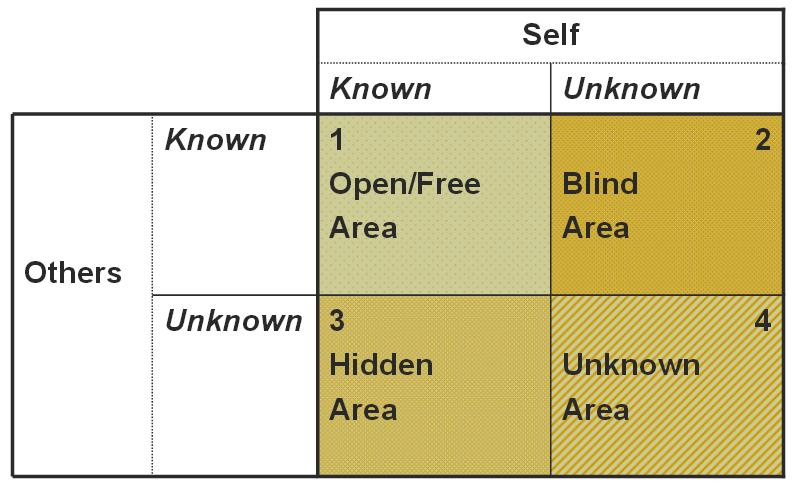
Why is it often times challenging and difficult to create awareness?  Remember the Johari Window?  A client may have all sorts of unexamined assumptions about herself and others, and what’s going on in relation to what the client asked to be coached on.

Johari Window

Johari.WindowFigure retrieved from Johari Window.

Even if the Johari Window may not be explicitly used during the coaching session, the coaching process helps the client explore the four perspectives represented in the table below, namely, the areas that are “unknown” or “hidden” from the client vs. areas that are “known” to herself and to others.

Creating awareness is not an end in itself but rather a means to “raise” the client’s starting point for constructive actions in moving forward in achieving her goals.

One executive who lamented that her team was not able to carry out and complete the projects they agreed to do during the year, later realized that it was her way of managing, or actually not sufficiently managing, her team so that they had a very clear idea of their project charter, their deliverables, their timetable, their resources. The team had gotten into the habit of letting the project schedule slip and were complacent in not producing their deliverables. There were no drastic consequences for failure to deliver.

She wanted her team to be successful but was not sure what else she should do. One question that helped to create a shift in awareness was, “What are you doing, or not doing, that’s keeping them in the state“?  The point of the question was that before we can expect others to change, we must look to ourselves and ask what we must change in ourselves so that the others can change as well. It was a question that was meant to explore the client’s Blind Area.

The executive assumed that if she gave them the freedom and flexibility to direct their work and just checked on them a few months down the road, that the team would do better. However, more discussion revealed that the team probably didn’t really know what they they were expected to produce and by when.  They didn’t have all the required information, knowledge and skills necessary to successfully complete the project and didn’t ask for help either.  The team didn’t have sufficient initiative and commitment.  They had little sense of urgency.

Upon realizing that how she managed her team had an impact on their poor performance, she identified what she would do differently so as to help the team better understand the requirements of their internal clients and deliver on these.  The awareness enabled her to consider different ways of managing her team, experiment with these, observe more closely what worked and what didn’t, reflect on her experience and work with her team more effectively.

Click here to see the 11 ICF Core Coaching Competencies in this blog.

ICF Core Competency: Communicating Effectively – Direct Communication

The third competency under Communicating Effectively is Direct Communication. What does this mean?  Yes, it means calling a spade a spade but there’s more to it than that so as to elicit a positive outcome for the client.

7. Direct Communication – Ability to communicate effectively during coaching sessions, and to use language that has the greatest positive impact on the client.

  1. Is clear, articulate and direct in sharing and providing feedback.
  2. Reframes and articulates to help the client understand from another perspective what he/she wants or is uncertain about.
  3. Clearly states coaching objectives, meeting agenda, and purpose of techniques or exercises.
  4. Uses language appropriate and respectful to the client (e.g., non-sexist, non-racist, non-technical, non-jargon).
  5. Uses metaphor and analogy to help to illustrate a point or paint a verbal picture.

Source: Retrieved from ICF Core Coaching Competencies

Direct communication is about honest communication. The coach says what she sees, feels and senses, about what’s going on with her client.  Sometimes, when giving feedback that may be harsh or jarring, the coach shows respect by asking the client: “May I be honest with you?” before sharing her observations and perceptions.

In some instances, coaches may feel uncomfortable about telling their client what seems like the obvious truth because they are mindful about keeping the conversation’s impact positive and enabling the client to receive such feedback and act constructively.

One situation, for example, is when senior management may say they want to create a mentoring and coaching culture in their organization and attend workshops to learn the skills. However, the very same senior executives do not walk the talk, while expecting managers reporting to them to coach and mentor their subordinates. Let’s assume that senior management mean what they say, that they do really want to create such a supportive and developmental corporate culture. And, that they didn’t attend the workshop just for show or to go on a junket.

The coach who is working with senior management has the challenge of giving honest feedback about this discrepancy between what they say vs. what they are doing or not doing.  To be helpful, such feedback will need to be given in a manner that fosters self awareness, as well as encourages exploration of what may be hindering the client from engaging in coaching and mentoring, and what actions the client can take to actually mentor and coach their direct reports.

How the coach will communicate directly, the choice of words, the choice of metaphors, the timing, will be influenced by the coach’s knowledge about the client.

Click here to see the 11 ICF Core Coaching Competencies in this blog.

ICF Core Competency: Communicating Effectively – Powerful Questioning

The second competency under Communicating Effectively is Powerful Questioning. Relearning how to ask good questions is a skill that can be developed with practice.

6. Powerful Questioning – Ability to ask questions that reveal the information needed for maximum benefit to the coaching relationship and the client.

  1. Asks questions that reflect active listening and an understanding of the client’s perspective.
  2. Asks questions that evoke discovery, insight, commitment or action (e.g., those that challenge the client’s assumptions).
  3. Asks open-ended questions that create greater clarity, possibility or new learning.
  4. Asks questions that move the client toward what they desire, not questions that ask for the client to justify or look backward.

Retrieved from ICF Core Coaching Competencies.

The ability to ask powerful questions is related more to a coach’s ability to listen actively and dance with the moment and not just having a list of powerful questions in her back pocket.

The power of any question comes from it’s ability to create an “aha” eye opener moment for the client, enabling her to re-frame the challenge, issue or problem, and see it in a new perspective.  The shift in perception and thinking brings with it the opportunity for new and more options for possible solutions and actions that the client may not have thought of before.

If you would like to get a sense of what powerful questions may be like, here is a quick list in Powerful Questions from Co-Active Coaching

You can also pick up some points from Appreciative Inquiry: Asking Powerful Questions

And now for questions that may help change your life, visit 35 Questions That Will Change Your Life

Just remember that the power is not just in the question itself but whether it is the “right” one for the moment.

Click here to see the 11 ICF Core Coaching Competencies in this blog.

ICF Core Competency: Communicating Effectively – Active Listening

Now moving on to the third category of ICF Core Competencies…Communicating Effectively. The first point under it is Active Listening.

5. Active Listening – Ability to focus completely on what the client is saying and is not saying, to understand the meaning of what is said in the context of the client’s desires, and to support client self-expression.

  1. Attends to the client and the client’s agenda and not to the coach’s agenda for the client.
  2. Hears the client’s concerns, goals, values and beliefs about what is and is not possible.
  3. Distinguishes between the words, the tone of voice, and the body language.
  4. Summarizes, paraphrases, reiterates, and mirrors back what client has said to ensure clarity and understanding.
  5. Encourages, accepts, explores and reinforces the client’s expression of feelings, perceptions, concerns, beliefs, suggestions, etc.
  6. Integrates and builds on client’s ideas and suggestions.
  7. “Bottom-lines” or understands the essence of the client’s communication and helps the client get there rather than engaging in long, descriptive stories.
  8. Allows the client to vent or “clear” the situation without judgment or attachment in order to move on to next steps.

Retrieved from ICF Core Coaching Competencies.

One of the basic skills that I learned many years ago as a young management consultant was active listening to help me gather the facts and information about a client’s problem that I was working on. Active listening during coaching is more demanding in the sense that the coach must listen at deeper levels.

In her book Co-Active Coaching, Laura Whitworth et al identify three levels of listening.

Level I – Internal Listening: Listening to our own thoughts and judgements.

We hear what the client is saying but focus more on our own thoughts and what these might mean to us. Sometimes, we can lose track of what the client is saying because we are more tuned in to our own thoughts and feelings.

Level II – Focused Listening: Focus on what the client is saying.

We hear what the client is saying and how she is expressing herself. We hear the client’s context and use active listening skills such as questioning, restating, paraphrasing, and summarizing.

Level III – Global Listening: Focus on more than just the words.

We hear and feel the client’s emotions behind the words, the tone of voice, the body language. We have a heightened sense of awareness and are able to access our intuition. We use the skill of immediacy to help make the client aware of what is happening in the here and now during the coaching session.

Click here to see the 11 ICF Core Coaching Competencies in this blog.